
France
Bullion gold coin
United States





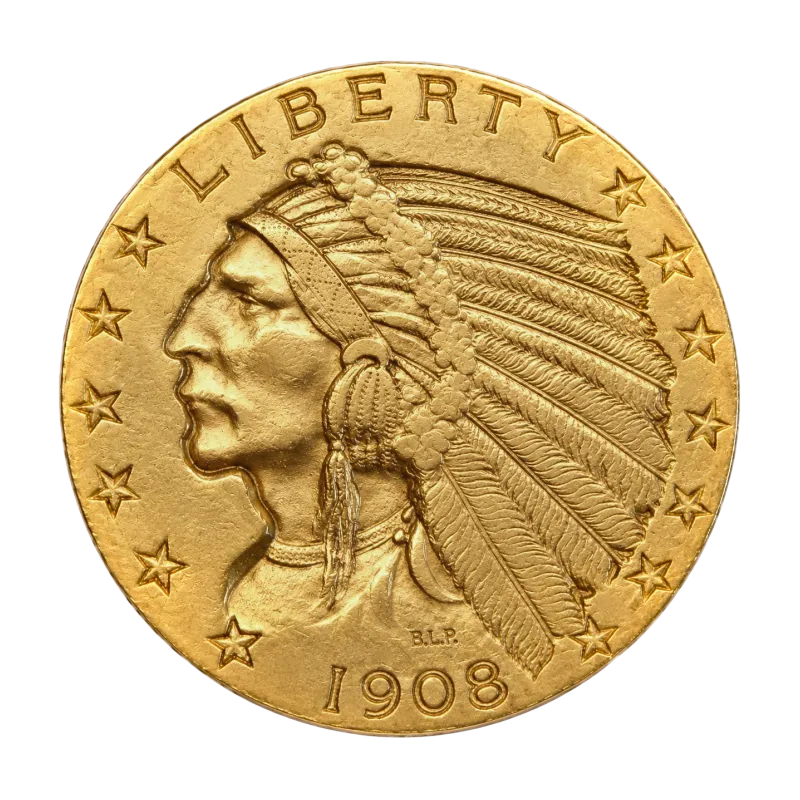
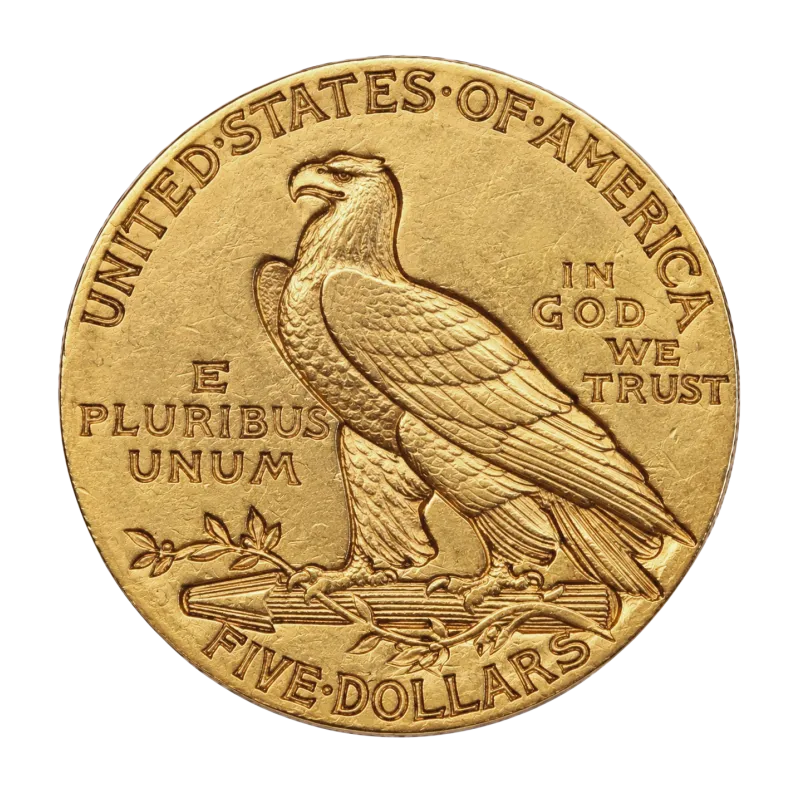
The US $5 Indian Head Half Eagle is an American gold coin designed by sculptor Bela Lyon Pratt and minted from 1908 to 1916, then again in 1929. It is distinguished by its incuse relief: the portrait of a Native American chief and the eagle on the reverse are engraved below the level of the coin’s field, rather than raised above it. The coin weighs 8.359 grams, has a gold fineness of 900‰ and contains approximately 7.523 grams of fine gold, with a diameter of 21.6 mm. The example featured on this page is dated 1908.
From 1904 onwards, President Theodore Roosevelt embarked on an artistic renewal of American coinage, which he considered outdated compared with contemporary European coins. He entrusted the project to sculptor Augustus Saint-Gaudens, who designed the new $10 and US $20 gold coins, introduced in 1907. Saint-Gaudens died on 3 August 1907, before he had time to design the smaller denominations included in the programme — the $5 coin was therefore never his creation.
For this denomination and the $2.50 coin, Roosevelt turned to another proposal. Dr William Sturgis Bigelow, a collector and friend of the President, suggested drawing inspiration from Egyptian bas-reliefs he had observed, by engraving the design below the level of the coin’s field rather than raising it above the surface. Roosevelt approved this unusual idea and entrusted its execution to sculptor Bela Lyon Pratt, who had trained within Saint-Gaudens’ circle.
The new type was introduced in 1908. Recognisable by its incuse relief, described in the following chapter, it introduced a technique previously unseen in regular United States coinage. The example featured on this page bears this inaugural date. The type was minted only from 1908 to 1916, then again in 1929, as detailed later in this dossier.
On this coin, the portrait, the eagle, the inscriptions and even the individual letters are engraved below the level of the coin’s field, rather than raised above it as on almost all other coins. This is known as incuse relief: the forms remain fully sculpted, but are recessed beneath the surface rather than projecting above it. Only the mintmark, when present, is rendered in conventional raised relief. The technique attracted criticism from the outset, with some observers fearing that the recessed areas would trap dirt more easily. These concerns did not, however, prevent the adoption of the new design.
The obverse depicts the left-facing profile of a Native American chief wearing a feathered headdress, surrounded by the inscription “LIBERTY” and thirteen stars representing the original colonies. The portrait has traditionally been associated with the Sioux chief Hollow Horn Bear, but this attribution remains disputed. More recent numismatic research has qualified the identification, and no definitive consensus has emerged regarding the precise identity of the model. The date appears at the bottom of the obverse, beneath the portrait.
The reverse depicts an eagle with folded wings, perched on a bundle of arrows and holding an olive branch in its talons. It is surrounded by the inscriptions “UNITED STATES OF AMERICA”, “IN GOD WE TRUST” and “E PLURIBUS UNUM”, with the denomination “FIVE DOLLARS” below. The design was adapted for minting by the Mint’s Chief Engraver, Charles E. Barber, from Pratt’s original sketch. It also appears on the $2.50 gold coin of the same type, which is not featured on this website.
Production of the US $5 Indian Head Half Eagle was distributed among several United States Mint facilities. Coins struck in Philadelphia have no mintmark, those from Denver bear the letter D, and those from San Francisco the letter S. The New Orleans Mint produced this type in only one year, 1909, using the mintmark O. When present, the mintmark appears on the reverse, to the left of the bundle of arrows.
Regular production of the type ended after 1916, without an official decree terminating the series, as demand for smaller gold denominations gradually declined. Minting resumed only in 1929, with an original mintage of 662,000 coins, before ceasing permanently. A large proportion of this issue was held by the United States Treasury and subsequently melted down following the 1933 measures restricting gold ownership in the United States. This explains its present-day rarity.
Within this series, struck in different years and at several mints, certain issues stand out markedly from the others. The 1909-O, the only issue struck in New Orleans, had the lowest original mintage of the entire series, at 34,200 coins. The 1929 issue, by contrast, had a relatively high original mintage but owes its present-day rarity to the extensive melting described above. These two examples illustrate why original mintage, the number of coins certified by grading services and the number of surviving examples must not be confused. They are three distinct measures that rarely coincide for any given issue.
The US $5 Indian Head Half Eagle has a theoretical weight of 8.359 grams, a gold fineness of 900‰ and a diameter of 21.6 mm. It therefore contains approximately 7.523 grams of fine gold, with the remainder of the alloy consisting of copper. These figures correspond to the official specifications of the type; a circulated example may differ slightly depending on its state of preservation.
The incuse relief of the portrait and eagle is one of the principal distinguishing features of this type. The same technique was also used on the American $2.50 Indian Head gold coin designed by Bela Lyon Pratt. This recessed relief protects the engraved designs from wear because they are not directly exposed to friction. The surrounding flat field, however, remains exposed and may show handling or contact marks, just as on any other coin. Incuse relief therefore does not, in itself, guarantee a better state of preservation. The mintmark, when present, is found on the reverse, to the left of the bundle of arrows. Unlike the surrounding incuse design, it remains in raised relief. Its absence indicates Philadelphia, while the letters D, S and O identify Denver, San Francisco and New Orleans respectively. The example featured on this page is dated 1908. Since several mints produced this coin in that year, the date alone is not sufficient to determine its mint of origin.
The weight, diameter, inscriptions and reeded edge must be examined together. None of these characteristics, considered individually, is sufficient to establish a coin’s authenticity. In cases of doubt, an assessment by a professional with expertise in numismatics remains necessary.
The value of a US $5 Indian Head Half Eagle depends first on the 7.523 grams of fine gold it contains, whose price continually follows movements in the gold market. Other factors specific to each example may also play a role, as explained in the remainder of this chapter.
The date, mint of origin and state of preservation of an example play an important role in its valuation. Certain issues, such as the 1909-O and 1929 discussed in the previous chapter, are sought after for different reasons — an exceptionally low original mintage in the former case and rarity resulting from melting in the latter — while other dates and mintmarks remain more common. These characteristics must be assessed individually for each coin rather than applied to the entire type.
Examining the coin makes it possible to assess its authenticity and state of preservation, taking particular account of its weight, relief, edge and inscriptions. Its valuation then depends on the gold price and the specific characteristics of the example, rather than on a generic price applicable to the entire type.
Explore the collection
Other coins, other eras, one shared history of gold.
France
Switzerland
France
United Kingdom
Mexico
United States
Germany
South Africa
Discover all the gold coins in our numismatic collection.