
France
Bullion gold coin
Germany





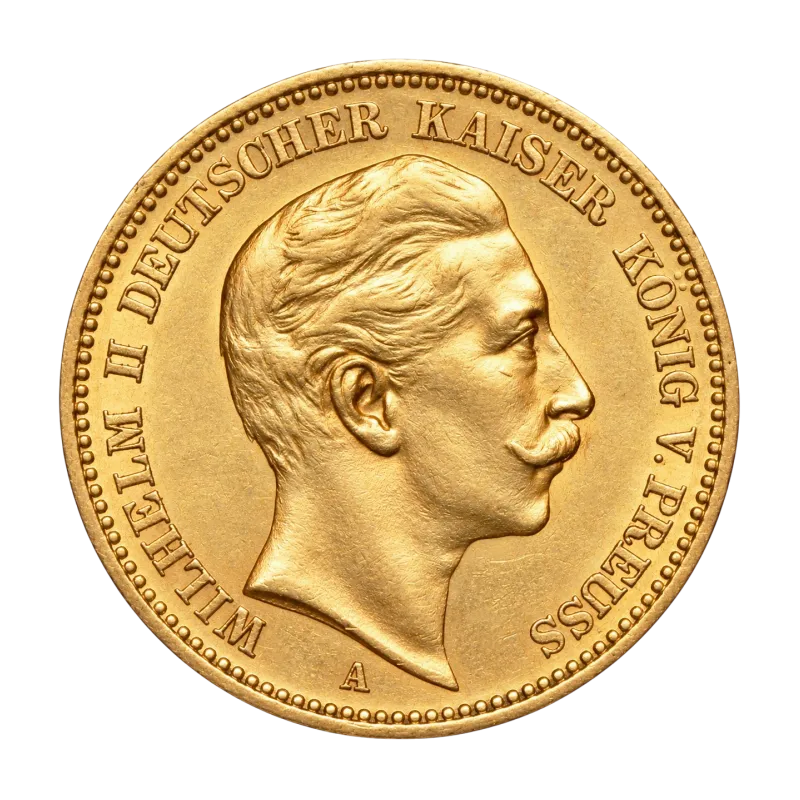
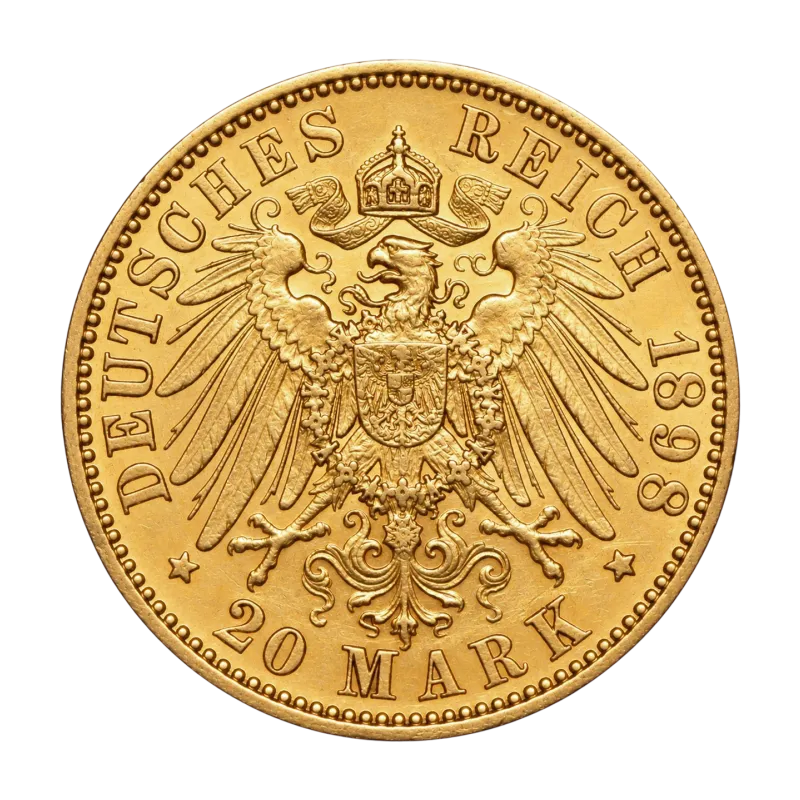
The 20 German Marks Wilhelm II gold coin was issued by the Kingdom of Prussia within the German Empire during the reign of Emperor and King Wilhelm II. The example featured on this page is dated 1898 and bears the mintmark A, identifying the Berlin Mint. Recognisable by its portrait of Wilhelm II and the crowned imperial eagle, it weighs 7.965 grams, has a gold fineness of 900‰, contains approximately 7.17 grams of fine gold and measures 22.5 mm in diameter.
The monetary unification of the German Empire began with the Reichsmünzgesetz, the Imperial Coinage Act of 4 December 1871, supplemented by a second law on 9 July 1873 that set the country on the path towards the gold standard. The Mark became the Empire’s common currency, introduced throughout the federated states by 1 January 1876.
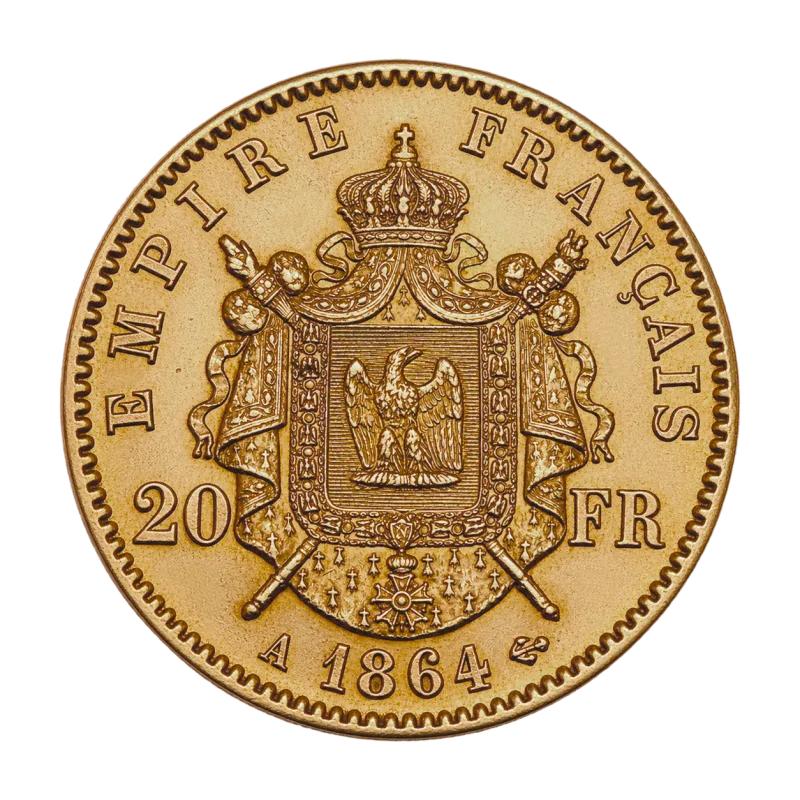
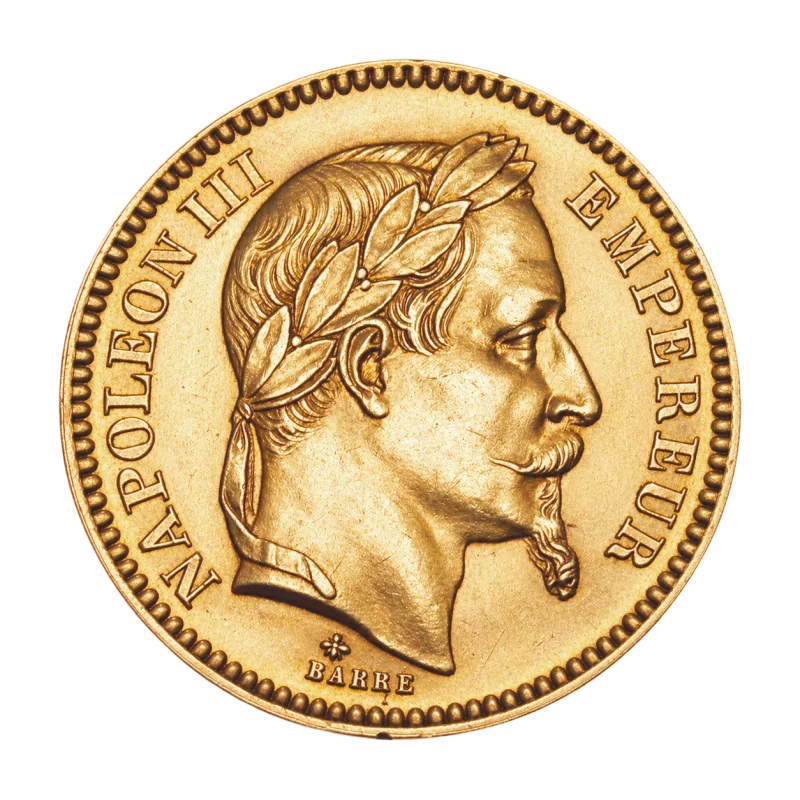
This transition to the gold standard was facilitated and accelerated by the war indemnity paid by France following the Franco-Prussian War of 1870–1871, although it was neither the sole cause nor the exclusive source of funding for the reform. The gold received contributed to the reserves used by the German Empire to implement its monetary reform. The same war brought an end to the French Second Empire and to the production of the 20 Francs Napoleon III, also featured on this website — two coins shaped, each in its own way, by the upheavals of this period.
For the higher gold denominations, each state within the Empire retained the right to mint its own coins. Prussia, Bavaria and Saxony therefore issued distinct 20 Mark gold coins, each bearing the portrait of its own ruler, while sharing a broadly similar reverse design centred on the imperial eagle, a symbol common to the Empire as a whole. The coin featured on this page belongs to the Prussian issue.
Wilhelm II ruled Prussia and the German Empire from 1888 to 1918. His portrait appears on Prussian gold coins struck during this period, alongside the letter identifying the mint responsible for their production.
The portrait of Wilhelm II occupies the centre of the obverse, facing right and surrounded by the inscription “WILHELM II DEUTSCHER KAISER KÖNIG V. PREUSS”. The mintmark appears below the bust. The design was created by sculptor Reinhold Begas, while its execution on the coin die at the Berlin Mint was the work of engraver Emil Weigand.
The reverse features an imperial eagle with outstretched wings, surmounted by a crown and surrounded by the inscription “DEUTSCHES REICH 1898” and the denomination “20 MARK”. Introduced in 1890, this design replaced an earlier composition featuring a smaller eagle and a large shield. Our example, struck after that date, therefore bears the later type with the large imperial eagle.
The edge bears the incuse motto “GOTT MIT UNS” (“God with us”), inherited from the electoral arms of Brandenburg and adopted by Prussia as early as 1701. Over time, it became a motto associated with the Prussian army and was subsequently used on the gold coins of the German Empire, carrying forward a symbol that long predated the minting of this coin.
Gold coin production in the German Empire was distributed among several regional mints, each identified by a letter. Berlin, where our example was struck, used the letter A. This system allowed the Empire to distribute production while maintaining strictly identical official specifications across its mints.
The minting of 20 Mark gold coins continued until 1914, the year the First World War began. The conflict rapidly disrupted Germany’s monetary system: from August 1914, the convertibility of the Mark into gold was suspended, and gold coins gradually disappeared from everyday circulation.
The 20 Mark gold coin lost its legal tender status on 16 August 1938, under a Reich ordinance dated 16 July 1938 concerning 10 and 20 Mark gold coins. A related ordinance required gold coins to be surrendered to the Reichsbank before 1 September 1938. This measure formed part of the Nazi regime’s policy of controlling gold, rather than merely reflecting a change in monetary circulation. Today, these coins are preserved and traded as collectors’ items or investment gold coins.
The 20 German Marks Wilhelm II gold coin has a theoretical weight of 7.965 grams and a diameter of 22.5 mm. Struck in an alloy containing 900‰ gold, it holds 7.1685 grams of fine gold. These figures correspond to the official specifications of the coin type; slight variations in weight may be observed in examples that have circulated or show signs of wear.
Its dimensions are similar to those of French and Swiss 20-franc gold coins, particularly the 20 Swiss Francs Vreneli. However, this similarity in size should not obscure the differences in weight and fineness between the two monetary systems.
The obverse depicts Wilhelm II, German Emperor and King of Prussia, with his portrait accompanied by his titles. The reverse features the crowned imperial eagle, the inscription DEUTSCHES REICH, the date and the denomination 20 MARK.
The edge bears the incuse motto GOTT MIT UNS (“God with us”). Examining these three parts helps distinguish this Prussian issue from other gold coins of the German Empire.
On 20 German Marks Wilhelm II gold coins of this type, the mintmark appears on the obverse, beneath the portrait, while the date appears on the reverse.
The example illustrated on this page is dated 1898 and bears the letter A, identifying the Berlin Mint. These details allow the issue to be identified more precisely than by its denomination alone.
For gold coins of the German Empire struck during the reign of Wilhelm II, the historically correct denomination is 20 Mark, as inscribed on the coin itself.
The term “20 Reichsmarks”, sometimes encountered in the numismatic trade, is anachronistic for these issues: the Reichsmark was not introduced until 1924. Both expressions may therefore be used commercially to refer to the same imperial coin, but only the former corresponds to its original denomination.
The weight, diameter, inscriptions, relief and edge must be examined together. None of these features, considered individually, is sufficient to establish a coin’s authenticity.
A photograph or an approximate weight measurement cannot replace a physical examination. In cases of doubt, an assessment by a professional with expertise in numismatics remains necessary.
The value of the 20 German Marks Wilhelm II gold coin is primarily based on the 7.1685 grams of fine gold it contains, whose price continually follows movements in the gold price. Its value therefore changes over time and does not correspond to any fixed amount, whether buying or selling.
Beyond its gold content, the price of an example may vary according to its state of preservation, as well as its date and mint of origin, since certain issues are documented as rarer than others within the series. These factors must be assessed individually for each coin rather than applied to the entire type.
Only a direct examination of the coin makes it possible to verify its condition, date and mintmark and then provide an appropriate valuation. This assessment takes into account both the gold price and the particular characteristics of the example being examined, rather than relying on a generic price for the entire type.
Explore the collection
Other coins, other eras, one shared history of gold.
France
France
Switzerland
United Kingdom
United States
Mexico
South Africa
United States
Discover all the gold coins in our numismatic collection.